Showing posts with label teachers helping teachers. Show all posts

Monday, March 21, 2016

Time Hacks for Teachers - C - Creative Assessments

As I said before, this post will bring together the ideas of using oral feedback, always coaching and constantly assessing. I'm going to use the concept of a summative test to illustrate creative assessments, but when we use the word creative, really, the sky's the limit.

Suppose I'm covering a standard with five strands, as I've used in prior posts. And, suppose my summative test has four questions per strand (yeah, like that ever happens). Because I'm constantly assessing, not ever student really needs to answer all twenty questions for me to finish assessing their knowledge of the standards (See figure 1 - If you haven't read Time Hacks for Teacher - C - Constantly Assessing you might want to go back and read it.)
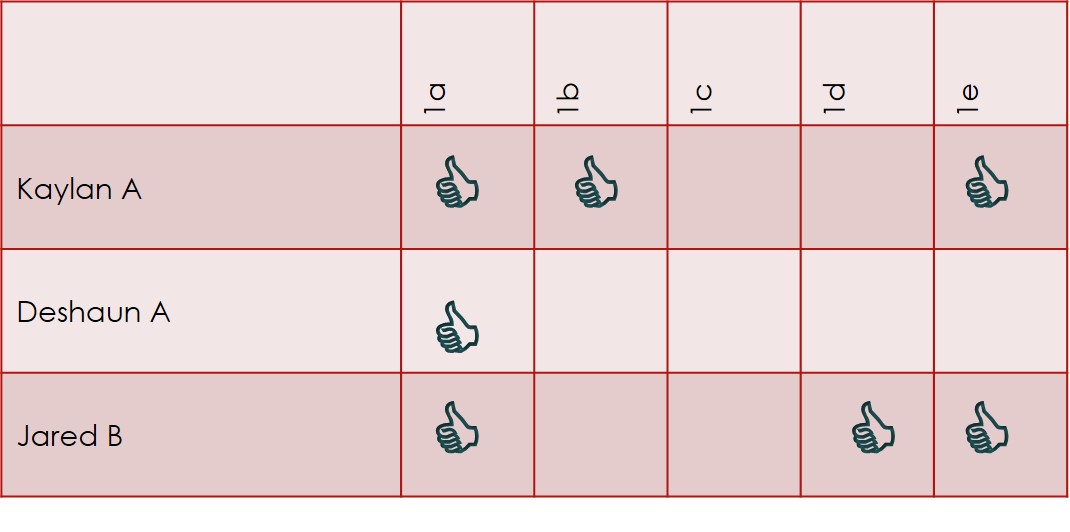
figure 1

Obviously, it could get a little crazy on test day if I'm telling Kaylan, "Okay, you only neded to answer questions 6-10 and 16-20," but I'm telling Jared he needs to answer 1-5 and 16-20. Even if I don't tell the kids anything, and let all of them answer all the questions, then I only grade the ones they need it could be confusing (not so much if I set up my test like I talked about in Time Hacks for Teachers - O - Oral Responses Give Immediate Feedback - see figure 2)

figure 2

But I found an even better way to alleviate the confusion. I began giving oral test. I know, I know, that takes longer, and I'm supposed to be saving you time. So let's address how I went about it first, and then look at how it actually saved me time.

My tests were posted on my door the day of the test, and were usually just diagrams, equations, pictures or paragraphs (see figure 3 for an example). But there were no questions. I'd made out the test questions, but I used the pictures or diagrams to get the discussion going. Figure 3 is an actual test, minus the questions of course. This was based on a project the kids had done, and I actually used three different students' work.

figure 3

I would bring kids out one at a time and begin talking about something in the project. The great thing is that for one student I might focus on C, and for another I might bounce around (When they go back in to discuss - something I expressly forbid them to do, but knew they would - they have a hard time figuring out what to talk about).

Because I've already assessed certain strands, I only ask Kaylan questions about the strands I still need to assess. Since I have my gradebook right there with me, no confusion. And I have the benefit of oral responses, so i can dig deeper for understanding if I need to.

Okay, so how does this save time if it actually takes longer? First, it's really hard to take an oral test home to grade, so everything's done in class. Victory! On top of that, let's say I'm assessing standard 1c, and I can tell Deshaun doesn't get it. Since I'm always coaching, I reteach right then, not in an after-school tutoring session a week after he took the test. I let him know that if I had graded his assessment it wouldn't have been pretty, and since I didn't want to see either of us cry I'm going to let him come back out and try again the next day. By doing that, I've placed reteaching and retesting both into class time - where they should be - not during my family time.

This strategy worked great for me, but here are a few things I want to point out:


  1. You obviously have to plan some self-directed work during your testing block. I usually took about one week for testing and retesting. On any given day that week, I might have spent half the period working with the whole class on the next unit, and then testing the other half of the period.
  2. Bring out your lowest performing students near the beginning. They can be tested, retaught and sent back in to study more, and then retested later in the week.
  3. Bring in your highest performing students near the beginning. I used to ask them questions way beyond what they needed to show mastery just to stretch them. If I had time, I would bring them back out to see if they had come up with answers to the questions I'd posed. These questions didn't effect their grade, and I let them know that, but often they would rise to the challenge. 


I want to challenge you to try this at least once to see how it works for you. Think about it: one unit with no tests to take home and grade, no tutoring sessions, no retest schedule. Sounds glorious, and it can be yours if you grade like a coach. Let me know how it turns out!


Wednesday, February 24, 2016

Time Hacks for Teachers - A - Always Coaching

Back when I played basketball, I loved game nights. There was always an air of excitement, a sense of comradery, and, for me, the hope I wouldn't do anything too embarrassing (if  I even got in the game - hey, I usually did). Coach Patterson would always give us some pep talk - "they put their pants on the same as you..." - before the game.

I want you to imagine for just a moment, Coach telling us, "You guys have practiced hard this week. I know you can beat this team. Good luck, and come talk to me after the game." Come talk to me after the game - what?

Maybe we would have still played our hearts out. Maybe Kyle or Keith would have led us to victory without the coach guiding us. Maybe not.

Can you imagine, the score is tied, ten seconds on the clock, we have the ball. Kyle calls a time out. We huddle up at the bench, and someone says, "Coach, what should we do?"

Then Coach Patterson crosses his arms over his dark blue sweater vest and says, "I can't help. This is the game."


That would be totally crazy, but let's take a similar situation in the classroom. I don't know how many times I told a student, "I can't help. This is a test." For many teachers, it doesn't sound crazy in this setting.

But I always hated saying to kids. Sometimes it would be a student like Josh, who would, for the first time the whole unit, actually be interested in knowing something (Perhaps it was the first time the whole unit held anything of value to him, but that's a different conversation.). Finally, Josh was receptive to my teaching, and I gave the standard teacher mantra - I can't help. This is a test.

Totally crazy!

I remember one test day, three students came up with very similar questions, and I told them I couldn't help. After the third student sat back down, looking defeated, a voice in my mind (yes, they're real) asked, "Why can't you help?" And, I answered it!

By the end of that conversation with myself (totally crazy???), I had come to the realization there was no rule saying I couldn't help students on test days.  Sure, if it is a State-mandated standardized test, but this was just me assessing a student in my classroom, and I'd missed a teachable moment.

What a doof! Three kids were struggling with the material it was MY job to teach, and I said, "No." On top of that, I had to give up time to tutor or reteach the material after the test, and then give a retest. And I DON'T HAVE ENOUGH TIME FOR ALL THAT!

If I'm honest, no matter how masterfully I present that information a second time, those three students will not be as engaged as they might have been when it mattered to them. I decided my standard teacher reply was merely a bad teaching practice, and Mark Barnes (@markbarnes19) said, "Bad practice adds up to disengaged students, who hate you and your class." (via www.brilliantorinsane.com)

After that day, I began to relish those pleas for help on test day. It's even been reported that I've stopped the whole test to reteach some point kids seem to be missing. Coaches are always coaching, on practice days and game days. Release your inner coach, even on game test day.

In the next post, I'm going to show you my greatest time-saving grading hack. It will pull together the ideas of constantly assessing, oral responses and always coaching. It's the one thing that truly turned grading into something I enjoyed. Don't miss it.

Let me pass the ball to you
Have you been guilty of saying, "I can't help. This is a test."? Have you tried anything else< and if so, how did it work?

Wednesday, January 6, 2016

Three Reasons You Should Be A Teacher-Leader

There is a lot of talk these days about teachers becoming teacher-leaders, and to many over-worked and under-payed teachers, that might sound like a joke. "Why would I want to add something else to my plate?" But I think it is something every teacher should consider, especially if you've been around for a while.

Unfortunately, some of the teachers who have been in teaching for a significant amount of time are burning out. The last thing they see as helpful is "doing more." But doing more is only drudgery if it's doing more of the same. Being a teacher-leader lets you step into something different.

Here are three reasons why becoming a teacher-leader can revitalize your career:

1. People need help

Everyone needs assistance sometimes, and if you have been a teacher for a while, you can help. Most of us find something intrinsically pleasing about helping someone in need. And, it doesn't have to take more of your time.

You already do some really great things. If I asked you, "What is your one "teacher super-power," or what do you do really well as a teacher, what would you say? If you are good at something, chances are you already do that thing often. How long would it take to send out an email that says, "Hey, I tried this in class and it worked wonderfully. Let me know if you'd like to know more."

By doing that one simple thing, you put yourself out there as someone who knows something. That's not too scary a place to be. Conversations may arise at the copy machine or the lunchroom, where you can share more with people who are curious. If no one seems curious about the thing you shared, it's okay. Perhaps it will be the next thing someone needs help with. Keep sharing.

2. You may need some help

If you share, you might just be an example to others who also begin to share. They might share something that could help you down the road. In fact, you all might become idea-sharing superheroes around your school.

Alright, so you might not be stopping bullets or leaping over tall buildings, but you could begin to form an amazing personal learning network (PLN). [Education needs more acronyms like Twitter needs more hashtags!] Why are personal learning networks important? "In a recent survey,Teachers Network found that 80 percent of teachers said network participation encouraged them to remain in the classroom, while 90 percent said that networking improved their teaching practice." (Edutopia)  

3. Get more out of your career

Education is a tough career, and one reason is because it is a relatively flat career. If you are a first year teacher, you are expected to create lessons, teach classes, maintain records, etc. If you are ten year teacher, you are expected to do the same things. 

There is little in the way of growth paths unless you stay out of the classroom. So when things get a little stale, teachers tend to change grade levels or subject areas, but after a while those changes too become stale. But by becoming a teacher-leader, you create another level in the teaching profession. 

The great thing about becoming a teacher-leader is that you get to make that move on your own. There's one department chair position, and the same person might hold that for years, but no one can stop you from reaching out to help your peers - and they won't want to! You can become a superhero to your administrators and peers alike. 

How have you, or someone in your school, demonstrated teacher-leadership?

Teacher-Leader PD Survey

Tuesday, December 15, 2015

Friday, December 11, 2015

Help! My file cabinet is empty - Looking at the first year

My first year of teaching was...a trip. I was hired two days before the school year started (and had to move to a new state). The department chair handed me keys, teacher's edition books for both physical science and biology, and a cart - since I would have no room of my own. Then she showed me a walk-in closet with a few desks - one of them was mine.

That was the last time I ever met with my department chair. I did see her a few times throughout that year, and perhaps she asked how I was doing. I probably lied. All I really remember was feeling completely lost.

Back when I began teaching, the internet was still in diapers, so we couldn't just "Google it." I'm not sure how many boring worksheets my students endured as I struggled to make lessons exciting and meaningful - and often failed. How would it have been different if I had been handed the whole curriculum - lesson plans, activities, guiding questions, all of it?

Sure, that might have been overwhelming, but so are the 274,500 results from a Google search. We've been teaching the same basic content for decades (Yes, of course there have been changes, but...), and yet new teachers still often enter the classroom with an empty file cabinet. Luckily, for many new teacher, and for their students, collaborative efforts within departments and teams are creating digital file cabinets with easy access for all. But we still need more teacher-leaders willing to step up and fill those empty file drawers.

How about you, did you have the support you needed that first year you taught? Have you been involved in helping a new teacher? Give us an idea of what you did.